
Author: Irina Nedelcu, Co-owner and Chief Operating Officer at Nutriland, specialist in food management and safety
Updated: November 13, 2026
In short: Casein is the main protein in milk, making up about 80% of cow's milk protein. In the stomach, it forms a curd, so amino acids are released more slowly than with whey protein. Studies have used 30-40 g of casein in the evening, before bedtime.
What is casein?
Casein is the protein that coagulates during cheese making. In the acidic environment of the stomach, it forms a curd, which means that the digestion and absorption of amino acids are slower and more prolonged than with whey protein. It contains all essential amino acids and is naturally present in cheeses, cottage cheese, and Greek yogurt.
What products contain casein?
Micellar casein appears in dedicated protein powders, in protein blends alongside whey, egg, or plant proteins, in protein bars and puddings, and in many high-protein foods.
What doses are usually used?
The ISSN position discusses consuming 30-40 g of casein before bedtime as part of the total protein intake for that day (Jäger et al., 2017). In a 12-week strength training study, young men received a drink containing 27.5 g of protein every evening before bedtime (Snijders et al., 2015). The main reference remains the total daily intake, which you can estimate with the protein calculator.
What forms are available?
Micellar casein retains the natural structure of milk protein and is the most common form in powder. Calcium or sodium caseinate is obtained by processing casein and is more commonly used as a food ingredient. There is also hydrolyzed casein, partially broken down into peptides. Casein powders are usually thicker when mixed than whey powders.
What can the label say?
For foods that are at least a source of protein, the following claims may be used: “Protein contributes to the growth of muscle mass,” “Protein contributes to the maintenance of muscle mass,” and “Protein contributes to the maintenance of normal bone health.” Expressions such as “anti-catabolic protein” or “overnight recovery” are not among the permitted formulations.
Casein products at Nutriland
- Casein Protein 1800 g, Rule One (micellar casein)
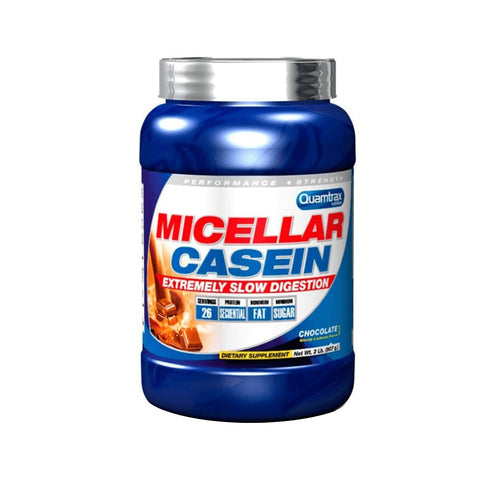
- Micellar Casein 1 kg, Quamtrax
- Micellar Casein 907 g, Quamtrax
The updated price and availability are displayed on each product page.
Read more
- Casein: what it is and its role in athletes' diets
- Casein Collection
- Protein calculator
- Dictionary: Whey protein
- Nutriland Ingredient Dictionary
Note: A varied and balanced diet and a healthy lifestyle are important. Follow the quantity and method of consumption on the product label and do not exceed the recommended daily dose. The products are not intended for children, pregnant or breastfeeding women; if you have a medical condition, consult your doctor before use.
Sources
- Jäger R et al. International Society of Sports Nutrition Position Stand: protein and exercise. Journal of the International Society of Sports Nutrition, 2017. pubmed.ncbi.nlm.nih.gov/28642676/
- Snijders T et al. Protein Ingestion before Sleep Increases Muscle Mass and Strength Gains during Prolonged Resistance-Type Exercise Training in Healthy Young Men. Journal of Nutrition, 2015. pubmed.ncbi.nlm.nih.gov/25926415/
- EFSA NDA Panel. Scientific Opinion on the substantiation of health claims related to protein and increase in satiety leading to a reduction in energy intake (...), growth or maintenance of muscle mass (...), maintenance of normal bone (...). EFSA Journal, 2010;8(10):1811. doi.org/10.2903/j.efsa.2010.1811